
If you’ve been staring at your website analytics lately feeling like something is off, you aren’t imagining it—and you certainly aren’t alone.
The frustration often lies in the details. It doesn’t always look like a catastrophic crash. Your keyword rankings might be holding steady. Your impressions might even be climbing. Yet, the metrics that actually keep the lights on—clicks, phone calls, form fills, and booked appointments—feel softer than they should.
That disconnect is the tell.
What you are experiencing isn’t the result of a single bad month or a punishing algorithm update. It is a structural shift in how human beings discover businesses online. The channels that used to reliably “deliver” attention, specifically search engines and social media, still matter, but they no longer behave the way they did even two years ago.
The businesses that rely on the playbook from 2023 are watching their results quietly erode. To stop the slide, we have to understand exactly what broke, why it looks like an “invisible” traffic drop, and what a practical pivot looks like for the year ahead.
The End of the Highway System
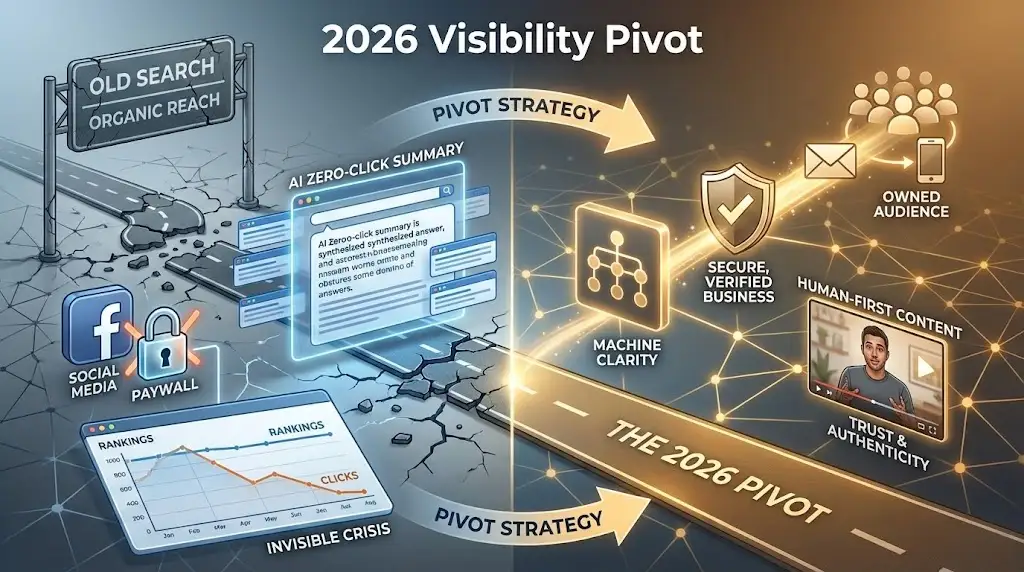
For two decades, search engines functioned like a digital highway system. Your job as a business owner was simply to get on the highway—by ranking well—and hope potential customers took your exit by clicking your link. If you played by the rules and published helpful content, you could count on a steady stream of visitors arriving at your site.
That era is over. Search has evolved from a directory into an answer engine.
Instead of routing users to a website to find information, modern results pages attempt to finish the task right there. Between AI summaries, featured snippets, map packs, and interactive product blocks, the goal of the search engine is to satisfy the query before the user ever leaves the page. Even if your content is the source material for that answer, the user may never visit your URL.
This is the “Zero-Click” reality. You can be perfectly visible, yet receive zero visits. Consequently, the metric that matters is shifting. It is no longer enough to ask, “Where do I rank?” We must now ask, “Where do I show up, and can the searcher trust me without ever clicking?”
The Social Paywall and the Fatigue Factor
A similar restriction is choking reach on social media. While these platforms still influence buying decisions, “organic reach” is effectively dead as a primary growth strategy. Most platforms now show your content to a tiny fraction of your own followers, essentially forcing you to pay for distribution.
This makes follower counts feel weirdly meaningless. A massive audience doesn’t automatically translate to visibility anymore. If you treat social media as a free channel that should produce consistent leads on its own, you will continue to be disappointed. A healthier model is to view social as a “trust layer”—a place for proof and personality—while accepting that scale now requires a budget.
Complicating this further is the fact that audience attention has become incredibly picky. The internet is currently flooded with “perfect” content—polished AI graphics, generic captions, and sanitized blog posts. People have seen the pattern so many times that they scroll right past it. This “AI fatigue” is a major problem for businesses that sound like everyone else, but it creates a massive opening for those willing to be clear, direct, and unpolished.
The Pivot: From Chasing Clicks to Building Authority
If you can’t count on free clicks the way you used to, the solution isn’t to panic or simply churn out more blog posts. The solution is to build a foundation that works whether people click or not.
First, you must master “Machine Clarity.” Many websites fail quietly because while they look fine to human eyes, they are vague to machines. In an AI-driven world, you need to use schema (structured data)—code that explicitly tells search engines who you are, what you sell, and where you operate. This reduces ambiguity, making it easier for AI systems to reference your business accurately in those zero-click summaries. Consistency across the web is key here; machines reward clarity, and ultimately, humans benefit from it too.
Second, stop building pages that just rank, and start building pages that convert. When traffic is harder to earn, every single visit has to do more heavy lifting. Your service pages cannot just be digital brochures; they need to answer the questions actually inside the visitor’s head. Do you have a clear next step? Is there social proof that is easy to scan? Do you offer helpful specifics on pricing and timelines? If you improve your conversion rate, you can withstand a traffic drop because the traffic you do get becomes more valuable.
Third, create content that cannot be summarized. If your content is generic enough to be written by anyone, it will be replaced by AI. The content that performs in 2026 is specific, opinionated, and grounded in real-world experience. You aren’t just answering questions; you are demonstrating expertise that an algorithm cannot fake.
Finally, own your audience. This advice is timeless, but the urgency is new. You must move your audience from rented land (social media) to owned land (email and SMS lists). Algorithms can hide your posts, but they cannot stop an email you send to a warm lead.
The Road Ahead
The internet is not dying; it is reorganizing. Search is becoming automated, social is becoming a “pay-to-play” environment, and generic content is being ignored.
If your traffic has dropped, don’t treat it as a mystery. Treat it as a signal. The old routes are less reliable, so it is time to build better ones: an owned audience, higher trust, better conversion rates, and a digital presence that both humans and machines can understand without guessing.