

In the modern digital economy, trust is a currency as valuable as capital. For a Business-to-Business (B2B) enterprise, establishing a transparent, reliable online presence is paramount. At BGRB, a boutique website design and digital media marketing agency based in Miami-Dade County, Florida, we built our platform on these exact principles. We operate as a fully remote agency serving clients across FL, NJ, NY, CA, and the United States, providing seamless digital solutions through virtual consultations. Our website is entirely ad-free, our phone number is prominently displayed, we offer an easy-to-use contact form, and we provide direct links to our corporate email. We operate with complete transparency because our clients expect nothing less.
Unfortunately, an automated secondary industry has emerged that complicates this digital ecosystem. Automated “validator” or “trust index” websites are increasingly utilizing the brand names of legitimate small businesses to generate traffic. By deploying programmatic SEO, these platforms generate auto-populated web pages that frequently label newly registered, verifiable businesses as “suspicious” or “unsafe.”
As a B2B agency dedicated to digital growth and online reputation management, we feel it is our responsibility to explain how these algorithmic directories operate, the data privacy concerns they raise, and how business owners can protect their digital footprint.

The Mechanics of Algorithmic Scoring
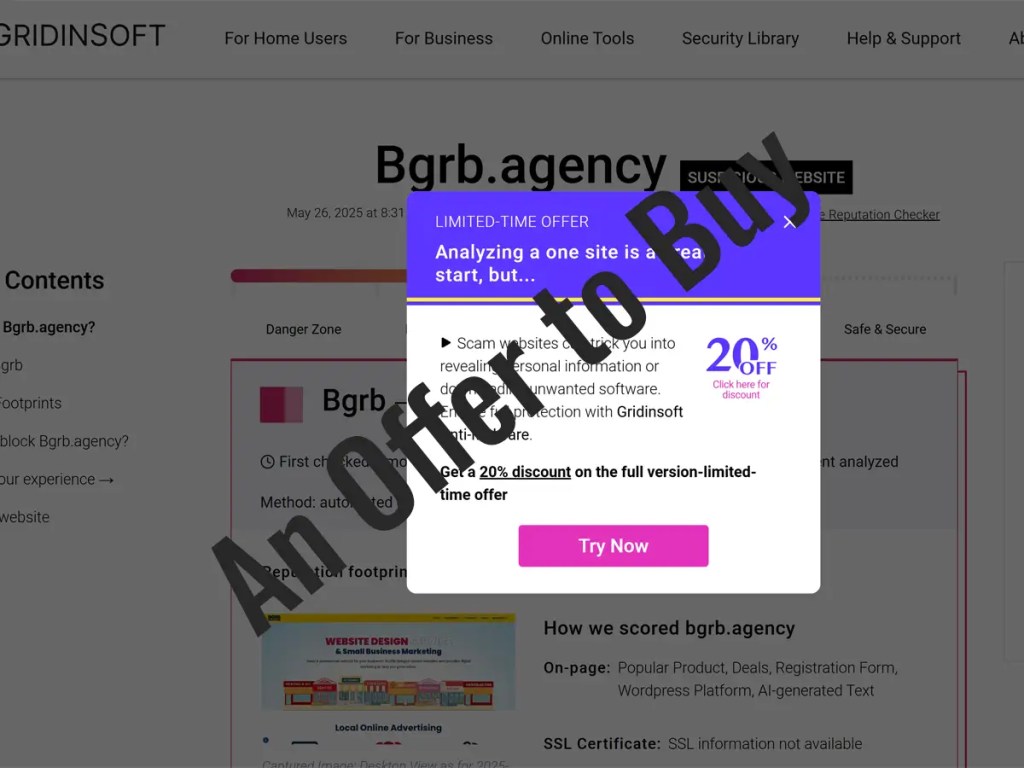
When a concerned consumer or prospective client searches for a business, they might encounter a page from a third-party domain scoring website. In the case of BGRB, one such site automatically generated a page assigning our legitimate domain a low “Trust Index” score, accompanied by tags suggesting the site was doubtful.
How are these scores calculated without human intervention? A technical analysis reveals that these sites rely heavily on automated WHOIS scraping and domain age metrics [1].
If a domain is relatively new, the algorithm automatically applies a penalty. It often ignores positive indicators such as the presence of a legitimate SSL certificate, the absence of malware, and a lack of spam reports. The algorithm’s function is to flag the business as a potential risk, which creates immediate concern for the user and keeps them reading the page.
The Monetization of Automated Directories
If these platforms are not conducting manual investigations into the businesses they review, what is their operational model? The answer lies in programmatic advertising and click-arbitrage [2].
Unlike BGRB’s website, which is designed for a clean, user-friendly B2B experience, the source code of typical automated review pages reveals an infrastructure saturated with ad-tech. These pages run exhaustive tracking pixels and highly dense display advertising networks.
Their business model operates on volume:
- Scrape the internet for newly registered, legitimate business domains.
- Auto-generate thousands of search-engine-optimized pages questioning the legitimacy of those businesses.
- Rank highly on search engines by capturing long-tail brand searches.
- Monetize the resulting traffic—often panicked business owners and cautious prospective clients—through heavy ad impressions.
Data Privacy Risks and “Verification” Demands
Perhaps the most concerning aspect of these automated platforms is their resolution process. After publishing an algorithmic assessment of a legitimate company, these sites often offer the business owner a chance to “challenge the trust score.”
To do so, they request that the business owner send an email to a generic inbox containing highly sensitive corporate information, including:
- Certificates of incorporation and business registration.
- The owner’s personal LinkedIn profile and social media accounts.
- Proof of satisfied customers, evidence of inventory, and internal business records.
In the B2B and cybersecurity sectors, sending sensitive corporate registrations and internal records to an unverified third party is a major data privacy risk. Verified corporate identities and owner documents are highly sensitive data points. Business owners should be extremely cautious and should not send certificates of incorporation, client data, or personal identification to automated third-party directories simply to alter an algorithmic score [3].
The Search Engine Dilemma
A frustrating element of this ecosystem is how search engines process these pages. As a digital marketing agency, BGRB understands the intricacies of Search Engine Optimization (SEO). It is disappointing when search engines—such as Bing—allow auto-generated, scraped-content pages to rank higher than the primary, verified business websites themselves.
Search engine algorithms are designed to prioritize authoritative, original content. Bing’s own Webmaster Guidelines explicitly warn against “scraped content” and pages with “thin content with little or no added value” [4]. When search engines allow algorithmic ad-farms to dominate search results for specific brand queries, they inadvertently penalize legitimate small businesses.

Actionable Steps for B2B Owners
If you are a business owner and you find your company targeted by one of these automated validators, here is how you should manage your online reputation:
- Protect Your Corporate Data: Do not send your incorporation documents, client records, or personal identification to a generic email address to “fix” an automated score.
- Understand the Source: Recognize that these sites are automated aggregators driven by ad-revenue, not official consumer protection agencies.
- Control Your Digital Footprint: Ensure your actual website is robust, transparent, and clearly displays your contact information. Claim your Google Business Profile, your Bing Places for Business, and maintain active, verified social channels to build genuine authority.
- Report Algorithmic Spam: Utilize the feedback and webmaster tools provided by Google and Bing to report pages that rely on scraped, thin content meant solely to manipulate search rankings without providing original value.
References & Industry Context
[1] ICANN & WHOIS Data Scraping: Automated directories frequently utilize public WHOIS data to programmatically generate pages based on domain registration dates. (Source: Internet Corporation for Assigned Names and Numbers (ICANN) Advisory on Data Harvesting).
[2] Programmatic Ad-Arbitrage: The practice of generating high volumes of low-quality, keyword-targeted pages to capture organic traffic and monetize it via display ad networks. (Source: Search Engine Journal: Understanding Programmatic SEO).
[3] Corporate Identity Theft & Phishing Vectors: The Federal Trade Commission (FTC) and Cybersecurity and Infrastructure Security Agency (CISA) consistently warn businesses against sharing sensitive corporate documents, EINs, and customer data with unverified third parties, as this is a primary vector for business identity theft. (Source: FTC – Scams and Your Small Business).
[4] Search Engine Quality Guidelines: Bing Webmaster Guidelines explicitly state that sites should “create unique, original content” and warns that pages resulting from “scraping or stitching content from other sites without adding value” will be demoted or removed from search indexes. (Source: Microsoft Bing Webmaster Guidelines – Content Quality and Scraped Content).
Frequently Asked Questions
Why is my business labeled suspicious online with a low scam detector trust index score?
Automated scam websites targeting businesses use programmatic SEO defamation and WHOIS scraping to generate auto-populated pages. They flag newly registered domains as suspicious to generate panic, operating as fake trust score websites rather than conducting legitimate human reviews.
How do I remove my business from scam detector and validator websites?
To remove a business from validator sites or fix a low trust index score, business owners must focus on protecting their B2B brand online through authoritative content and claiming their official Google and Bing business profiles. Do not comply with scam detector data demands for small businesses, as this can lead to data harvesting.
Should I send documents to a scam detector site to prove my legitimacy?
No. Sending corporate documentation to unverified third-party directories exposes you to corporate identity theft and scam detector phishing tactics. The FTC advises against sharing sensitive corporate data with ad arbitrage scam websites that extort small businesses.
Why is Bing ranking a scam detector over my real business website?
Search engines sometimes struggle to filter out thin content sites outranking legitimate businesses due to programmatic SEO abuse. Businesses must actively fight algorithmic defamation by building stronger online authority and reporting these auto-generated scam accusation pages directly to Google and Bing.
How do automated scam detector websites actually work?
They operate on a click-arbitrage model. They scrape public business data, generate an ‘is [business name] a scam’ review page, and rank it on search engines. When panicked business owners or clients click the link, the site monetizes the traffic through dense network advertising.